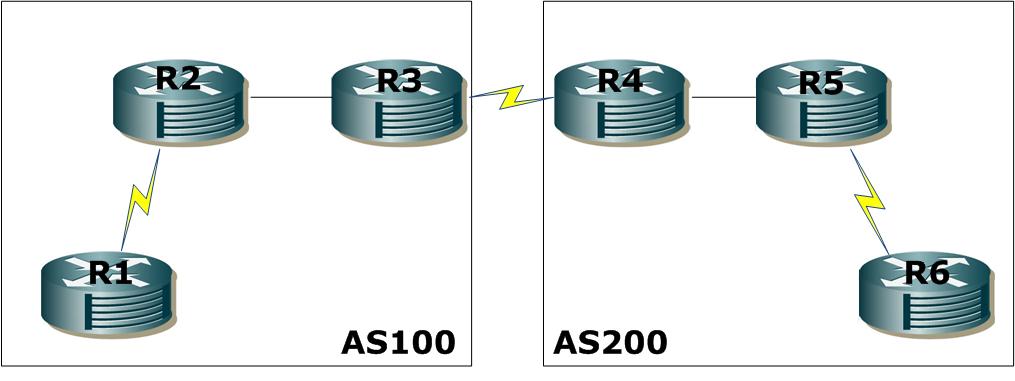
Issue
In
this example we will configure L2TPv3 between our PEs (R2, R3) in order to achieve
IPv4 and IPv6 connectivity between our CEs (R1, R4)
Routing
protocol is use between the CEs is RIP version 2
Configuration
R1
R1#sh
run int lo0
interface
Loopback0
ip address 1.1.1.1 255.255.255.255
ipv6 address 2001::1/128
ipv6 rip RIPng enable
R1#sh
run int s1/0
interface
Serial1/0
ip address 192.1.14.1 255.255.255.0
encapsulation frame-relay
ipv6 address 2001:192:14::1/64
ipv6 rip RIPng enable
serial restart-delay 0
frame-relay map ipv6 2001:192:14::4 101
broadcast
frame-relay map ipv6 FE80::C804:13FF:FEA2:0
101 broadcast
frame-relay map ip 192.1.14.4 101 broadcast
frame-relay lmi-type ansi
R1#sh
run | sec router rip
router
rip
version 2
network 1.0.0.0
network 192.1.14.0
no auto-summary
ipv6
router rip RIPng
R2
R2#sh
run int lo0
interface
Loopback0
ip address 2.2.2.2 255.255.255.255
R2#sh
run int f2/0
interface
FastEthernet2/0
ip address 192.1.23.2 255.255.255.0
speed 100
duplex full
R2#sh
run int s1/0
interface
Serial1/0
no ip address
encapsulation frame-relay
R2#sh
run | sec pse
pseudowire-class
MSSK
encapsulation l2tpv3
ip local interface Loopback0
R2#sh
run | sec connect
connect
FR Serial1/0 202 l2transport
xconnect 3.3.3.3 14 pw-class MSSK
R2#sh
run | sec router ospf
router
ospf 1
router-id 2.2.2.2
log-adjacency-changes
network 2.2.2.2 0.0.0.0 area 0
network 192.1.23.2 0.0.0.0 area 0
R3
R3#sh
run int lo0
interface
Loopback0
ip address 3.3.3.3 255.255.255.255
R3#sh
run int f2/0
interface
FastEthernet2/0
ip address 192.1.23.3 255.255.255.0
speed 100
duplex full
R3#sh
run int ser1/0
interface
Serial1/0
no ip address
encapsulation frame-relay
R3#sh
run | sec pse
pseudowire-class
MSSK
encapsulation l2tpv3
ip local interface Loopback0
R3#sh
run | sec connect
connect
FR Serial1/0 303 l2transport
xconnect 2.2.2.2 14 pw-class MSSK
!
R3#sh
run | sec router ospf
router
ospf 1
router-id 3.3.3.3
log-adjacency-changes
network 3.3.3.3 0.0.0.0 area 0
network 192.1.23.3 0.0.0.0 area 0
R4
R4#sh
run int lo0
interface
Loopback0
ip address 4.4.4.4 255.255.255.255
ipv6 address 2001::4/128
ipv6 rip RIPng enable
R4#sh
run int s1/0
interface
Serial1/0
ip address 192.1.14.4 255.255.255.0
encapsulation frame-relay
ipv6 address 2001:192:14::4/64
ipv6 rip RIPng enable
serial restart-delay 0
frame-relay map ipv6 2001:192:14::1 404
broadcast
frame-relay map ipv6 FE80::C801:13FF:FE92:0
404 broadcast
frame-relay map ip 192.1.14.1 404 broadcast
frame-relay lmi-type ansi
R4#sh
run | sec router rip
router
rip
version 2
network 4.0.0.0
network 192.1.14.0
no auto-summary
ipv6
router rip RIPng
Note:
When
dealing with frame-relay and IPv6, we have to configure mapping to the link
local address as well which is extracted (and can be hardcoded) from the below
R1#sh
ipv6 interface serial 1/0 | inc link
IPv6 is enabled, link-local address is
FE80::C801:13FF:FE92:0
No Virtual link-local address(es):
R4#sh
ipv6 int s1/0 | inc link
IPv6 is enabled, link-local address is
FE80::C804:13FF:FEA2:0
No Virtual link-local address(es):
Verification
R1#sh
frame-relay map
Serial1/0
(up): ipv6 2001:192:14::4 dlci 101(0x65,0x1850), static,
broadcast,
CISCO, status defined, active
Serial1/0
(up): ipv6 FE80::C804:13FF:FEA2:0 dlci 101(0x65,0x1850), static,
broadcast,
CISCO, status defined, active
Serial1/0
(up): ip 192.1.14.4 dlci 101(0x65,0x1850), static,
broadcast,
CISCO, status defined, active
R1#sh
ip route rip
Codes:
L - local, C - connected, S - static, R - RIP, M - mobile, B - BGP
D - EIGRP, EX - EIGRP external, O -
OSPF, IA - OSPF inter area
N1 - OSPF NSSA external type 1, N2 -
OSPF NSSA external type 2
E1 - OSPF external type 1, E2 - OSPF
external type 2
i - IS-IS, su - IS-IS summary, L1 -
IS-IS level-1, L2 - IS-IS level-2
ia - IS-IS inter area, * - candidate
default, U - per-user static route
o - ODR, P - periodic downloaded static
route, H - NHRP
+ - replicated route, % - next hop
override
Gateway
of last resort is not set
4.0.0.0/32 is subnetted, 1 subnets
R 4.4.4.4 [120/1] via 192.1.14.4,
00:00:00, Serial1/0
R1#ping
4.4.4.4
Type
escape sequence to abort.
Sending
5, 100-byte ICMP Echos to 4.4.4.4, timeout is 2 seconds:
!!!!!
Success
rate is 100 percent (5/5), round-trip min/avg/max = 16/19/24 ms
R1#traceroute
4.4.4.4 numeric
Type
escape sequence to abort.
Tracing
the route to 4.4.4.4
1 192.1.14.4 16 msec * 16 msec
R1#sh
ipv6 route rip
IPv6
Routing Table - default - 5 entries
Codes:
C - Connected, L - Local, S - Static, U - Per-user Static route
B - BGP, R - RIP, I1 - ISIS L1, I2 -
ISIS L2
IA - ISIS interarea, IS - ISIS summary,
D - EIGRP, EX - EIGRP external
ND - Neighbor Discovery
O - OSPF Intra, OI - OSPF Inter, OE1 -
OSPF ext 1, OE2 - OSPF ext 2
ON1 - OSPF NSSA ext 1, ON2 - OSPF NSSA
ext 2
R 2001::4/128 [120/2]
via FE80::C804:13FF:FEA2:0, Serial1/0
R1#ping
2001::4
Type
escape sequence to abort.
Sending
5, 100-byte ICMP Echos to 2001::4, timeout is 2 seconds:
!!!!!
Success
rate is 100 percent (5/5), round-trip min/avg/max = 12/19/28 ms
R1#traceroute
2001::4
Type
escape sequence to abort.
Tracing
the route to 2001::4
1 2001:192:14::4 12 msec 16 msec 16 msec
R4#sh
frame-relay map
Serial1/0
(up): ipv6 2001:192:14::1 dlci 404(0x194,0x6440), static,
broadcast,
CISCO, status defined, active
Serial1/0
(up): ipv6 FE80::C801:13FF:FE92:0 dlci 404(0x194,0x6440), static,
broadcast,
CISCO, status defined, active
Serial1/0
(up): ip 192.1.14.1 dlci 404(0x194,0x6440), static,
broadcast,
CISCO, status defined, active
R4#sh
ip route rip
Codes:
L - local, C - connected, S - static, R - RIP, M - mobile, B - BGP
D - EIGRP, EX - EIGRP external, O -
OSPF, IA - OSPF inter area
N1 - OSPF NSSA external type 1, N2 -
OSPF NSSA external type 2
E1 - OSPF external type 1, E2 - OSPF
external type 2
i - IS-IS, su - IS-IS summary, L1 -
IS-IS level-1, L2 - IS-IS level-2
ia - IS-IS inter area, * - candidate
default, U - per-user static route
o - ODR, P - periodic downloaded static
route, H - NHRP
+ - replicated route, % - next hop
override
Gateway
of last resort is not set
1.0.0.0/32 is subnetted, 1 subnets
R 1.1.1.1 [120/1] via 192.1.14.1,
00:00:12, Serial1/0
R4#ping
1.1.1.1
Type
escape sequence to abort.
Sending
5, 100-byte ICMP Echos to 1.1.1.1, timeout is 2 seconds:
!!!!!
Success
rate is 100 percent (5/5), round-trip min/avg/max = 16/18/20 ms
R4#traceroute
1.1.1.1 numeric
Type
escape sequence to abort.
Tracing
the route to 1.1.1.1
1 192.1.14.1 16 msec * 16 msec
R4#sh
ipv6 route rip
IPv6
Routing Table - default - 5 entries
Codes:
C - Connected, L - Local, S - Static, U - Per-user Static route
B - BGP, R - RIP, I1 - ISIS L1, I2 -
ISIS L2
IA - ISIS interarea, IS - ISIS summary,
D - EIGRP, EX - EIGRP external
ND - Neighbor Discovery
O - OSPF Intra, OI - OSPF Inter, OE1 -
OSPF ext 1, OE2 - OSPF ext 2
ON1 - OSPF NSSA ext 1, ON2 - OSPF NSSA
ext 2
R 2001::1/128 [120/2]
via FE80::C801:13FF:FE92:0, Serial1/0
R4#ping
2001::1
Type
escape sequence to abort.
Sending
5, 100-byte ICMP Echos to 2001::1, timeout is 2 seconds:
!!!!!
Success
rate is 100 percent (5/5), round-trip min/avg/max = 12/16/20 ms
R4#traceroute
2001::1
Type
escape sequence to abort.
Tracing
the route to 2001::1
1 2001:192:14::1 12 msec 12 msec 16 msec
R2#show
l2tp tunnel summary
L2TP
Tunnel Information Total tunnels 1 sessions 1
LocTunID RemTunID
Remote Name State Remote Address Sessn L2TP Class/
Count VPDN Group
4166035714
3475960279 R3 est 3.3.3.3 1
l2tp_default_cl
R2#show
l2tp session brief
L2TP
Session Information Total tunnels 1 sessions 1
LocID TunID
Peer-address State Username, Intf/
sess/cir Vcid, Circuit
3186344884
4166035714 3.3.3.3 est,UP
14, Se1/0:202
R3#show
l2tp tunnel summary
L2TP
Tunnel Information Total tunnels 1 sessions 1
LocTunID RemTunID
Remote Name State Remote Address Sessn L2TP Class/
Count VPDN Group
3475960279
4166035714 R2 est 2.2.2.2 1
l2tp_default_cl
R3#show
l2tp session brief
L2TP
Session Information Total tunnels 1 sessions 1
LocID TunID
Peer-address State Username, Intf/
sess/cir Vcid, Circuit
1379301905
3475960279 2.2.2.2 est,UP 14, Se1/0:303